NETANYAHU’S GREATEST ADVANTAGE: HE CAN AFFORD TO WAIT—BUT CAN THE OPPOSITION?
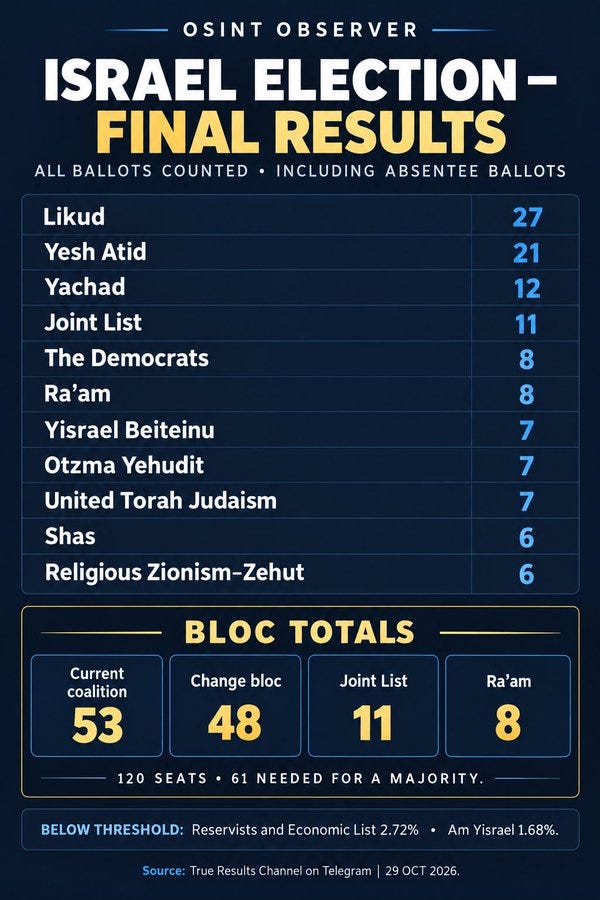
Israel’s election results have produced a fascinating political reality: Neither bloc has a majority, but Prime Minister Benjamin Netanyahu may have a significant strategic advantage.
With 53 seats for Netanyahu’s bloc, 48 for the change bloc, and 19 for the Arab parties, the opposition faces a difficult political dilemma.
Without the Arab parties, the change bloc cannot reach 61 seats on its own. But relying on their support presents serious political and ideological obstacles, particularly after campaign commitments and amid controversy surrounding allegations of foreign election interference.
And with 19 seats, the Arab parties would represent a substantial parliamentary force, not an insignificant addition to the coalition equation.
NETANYAHU KNOWS THE ARITHMETIC.
In my assessment, Netanyahu has little incentive to offer the opposition everything it wants merely to establish a unity government.
Any potential partners would have to make compromises, and Netanyahu can negotiate knowing that his opponents face difficult alternatives.
He does not need to chase them. He can afford to let them come to him.
TIME IS AN IMPORTANT PART OF HIS STRATEGY.
Under Israeli law, the outgoing government continues serving until a new government is formed. If coalition negotiations collapse, another election is possible.
That gives Netanyahu an alternative to accepting an unfavorable coalition agreement: remain in office in a caretaker capacity while the political process unfolds.
A new election carries risks for everyone. But Netanyahu may calculate that returning to the voters is preferable to surrendering major concessions to political rivals.
He may even believe that another election could strengthen his bloc enough to reduce his dependence on opposition partners. That is a political gamble, but one he has the option of considering.
THE OPPOSITION ALSO FACES A CREDIBILITY TEST.
During the campaign, opposition leaders portrayed Haredi military conscription as an urgent national security necessity, essential to the IDF and Israel’s survival.
Now, any attempt to negotiate a compromise with ultra-Orthodox parties to secure their coalition support would invite serious questions about those earlier commitments.
The same questions apply to left-leaning media commentators who championed uncompromising positions during the campaign but may now find themselves defending coalition concessions they previously criticized.
If the Haredi draft was an existential national issue before the election, why should its urgency change afterward?
And if those principles become negotiable for political convenience, what will voters make of those promises in the next election?
WHO BLINKS FIRST? BENNETT-LAPID OR EIZENKOT?
This is where Netanyahu’s negotiating advantage becomes particularly interesting.
Netanyahu does not need the entire opposition to join him. He needs only one opposition faction capable of delivering the seats necessary for a majority.
That creates a potential competition between Bennett-Lapid and Eizenkot.
Each must consider whether the other could reach an agreement with Netanyahu first, securing greater influence, more significant cabinet positions, and better coalition terms.
The first to strike a deal could negotiate from a stronger position. Anyone approaching Netanyahu afterward might discover that his need for additional partners has diminished considerably.
And Netanyahu understands that dynamic.
Why should he offer major concessions today when waiting could improve his negotiating position tomorrow?
He can allow the opposition factions to weigh their options, assess their risks, and decide whether remaining outside government is worth the political cost.
THE BOTTOM LINE: NETANYAHU HAS OPTIONS. HIS OPPONENTS HAVE DIFFICULT DECISIONS.
He can negotiate a unity government, maintain his position while coalition talks continue, or take his chances with another election if the political process leads there.
His opponents must decide whether to compromise with the very man they spent the campaign trying to remove, attempt a difficult alternative coalition, or face voters again.
Netanyahu may not have won an outright parliamentary majority, but he could still hold substantial leverage over what happens next.
THE REAL QUESTION IS WHICH OPPOSITION FACTION, IF ANY, WILL BLINK FIRST—AND HOW MUCH LEVERAGE IT WILL STILL HAVE WHEN IT FINALLY COMES TO THE NEGOTIATING TABLE.